Overview
FreshVale Markets – A UK-based grocery retail chain operating multiple supermarkets, focused on fresh food distribution, inventory management, and efficient supply chain operations.
FreshVale Markets, a UK grocery retailer with 1,000–2,000 employees, was facing two problems at once: empty shelves where customers expected to find products, and unsold fresh food that stores had to throw away.
Sarah Mitchell, Head of Supply Chain, approached Red Star Technologies to improve how the business forecast demand and replenished stock. The aim was to keep products available while reducing waste, without leaving planners to manage every order through spreadsheets.
Initial Challenge
FreshVale's replenishment process relied on spreadsheets, fixed reorder rules and the experience of individual store managers. That experience was valuable, but the process could not consistently account for promotions, weather changes, holidays and local events across hundreds of stores.
The same product could sell out in one location and expire in another. Stockouts meant missed sales and disappointed customers. Excess fresh stock meant spoilage, markdowns and lost margin.
Several challenges shaped the project:
1. Forecasting at Scale
Tens of thousands of products across hundreds of stores had different demand patterns. Fast movers needed accurate predictions, while slow sellers needed useful estimates despite limited sales.
2. Anticipating Demand Changes
Promotions, temperature shifts, school holidays and local events could change buying patterns sharply. Historical sales alone did not capture all those influences.
3. Handling New Products
New launches and seasonal lines often had little or no sales history, but planners still needed a reasonable starting order.
4. Balancing Availability and Waste
Ordering more could protect against stockouts and increase spoilage. Ordering less could reduce waste and leave shelves empty.
5. Building Planner Confidence
Recommendations needed clear explanations and room for local judgement. Otherwise, teams would be unlikely to trust automated ordering.
Background
Red Star Technologies built a cloud-based forecasting and replenishment platform integrated with FreshVale's point-of-sale, warehouse and ERP systems.
Each night, sales transactions, stock levels, promotion calendars, supplier lead times and external signals entered a central data platform. The data was cleaned, validated and transformed into features for the forecasting models. Apache Kafka also supported streaming point-of-sale and stock updates.
Nightly forecasting & replenishment pipeline
-
 01
POS, stock & ERP data
-
 02
Kafka & Airflow pipelines
-
 03
Snowflake features
-
 04
Demand forecasts
-
 05
OR-Tools replenishment
-
 06
Approved supplier order
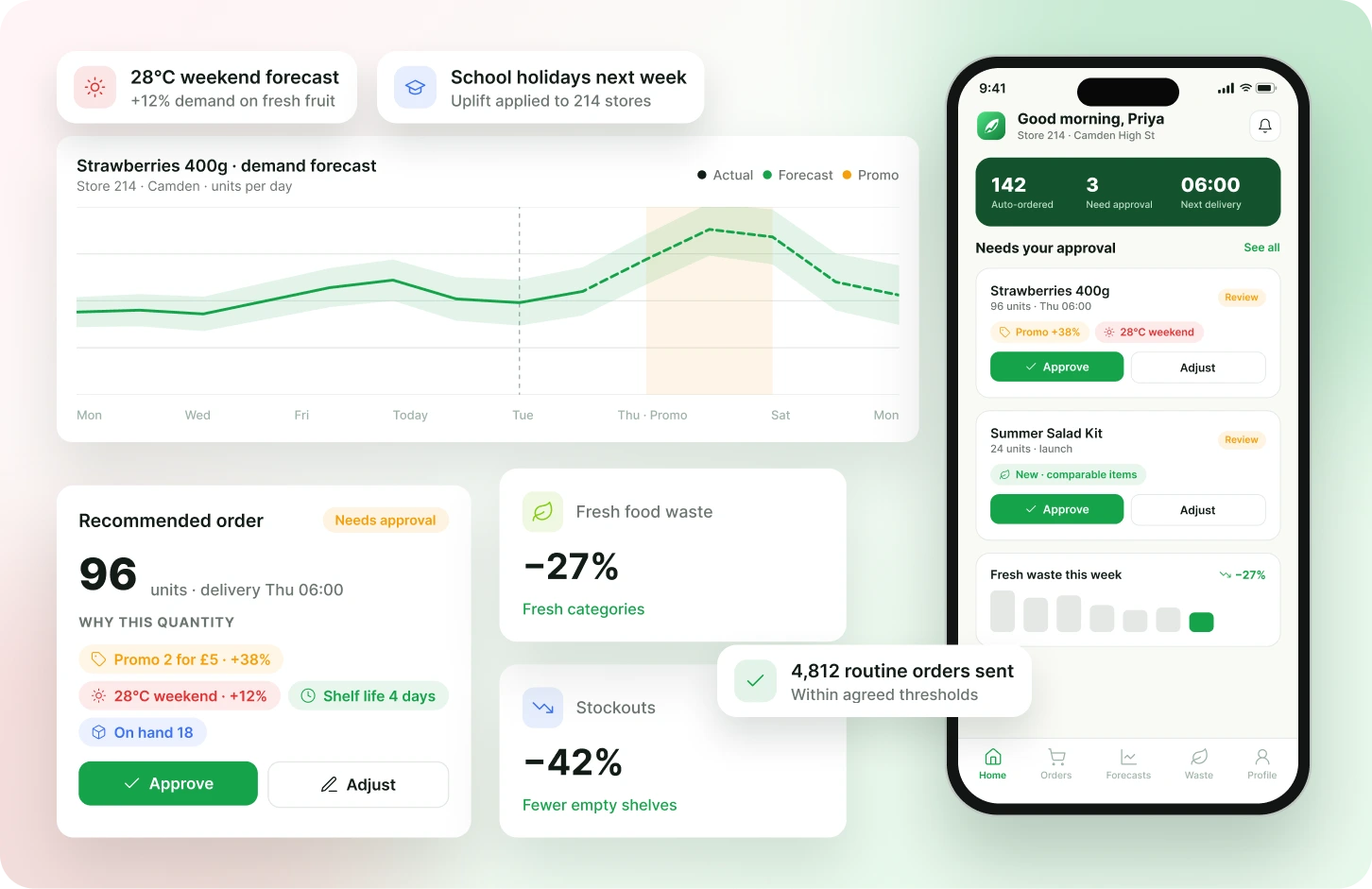
The models generated demand forecasts for each product-store combination across a rolling multi-week horizon. A replenishment engine then translated those forecasts into recommended orders, accounting for stock already available, shelf life, delivery schedules, supplier minimums and service targets.
Planners and store managers received a dashboard to review forecasts, track inventory health and investigate exceptions. Routine orders within agreed thresholds could go to suppliers automatically. Unusual recommendations remained subject to approval.
This connected the forecast to the actual ordering decision. Both needed to work for the platform to be useful.
Solution Design and Implementation
1. Built Shared Forecasting Models
We trained global LightGBM and XGBoost models to learn patterns across products and stores, avoiding the need to maintain thousands of separate models. Forecasts were reconciled across store, region and category levels so planners saw consistent figures at different levels of detail.
2. Added External and Promotional Signals
We incorporated promotion calendars, price changes, weather forecasts, public and school holidays, and local event data. Promotional uplift was modelled explicitly, helping the system anticipate demand before it appeared in sales figures.
3. Supported Multi-Horizon Forecasting
The platform included a PyTorch Temporal Fusion Transformer for multi-horizon and promotion-driven forecasts, supporting planning across the rolling forecast window.
4. Created Forecasts for Products with Limited History
For new and slow-selling items, we used attributes such as category, price band and pack size to draw on patterns from similar products. Forecasts updated as actual sales arrived, and planners could see when an estimate relied on comparable items rather than established history.
5. Developed a Constrained Replenishment Engine
Using probabilistic forecasts, product-level service targets, OR-Tools and business rules, the engine calculated order quantities around shelf life, lead times, supplier minimums and delivery schedules. Fresh items were tuned to limit waste, while high-priority products received protection against stockouts.
6. Made Recommendations Explainable
Planners could see the main drivers behind each recommendation, approve or adjust an order, and record an override reason that fed back into model improvement.
7. Introduced Automation Gradually
We first ran the platform alongside manual ordering. Auto-ordering was enabled category by category as accuracy was demonstrated, giving teams time to compare decisions and build confidence.
8. Connected with Operational Systems
REST APIs and EDI connectors linked the platform with ERP, warehouse management and supplier ordering. The React.js dashboard gave planners and store managers visibility into forecast accuracy, stockouts, waste and inventory health.
The Results
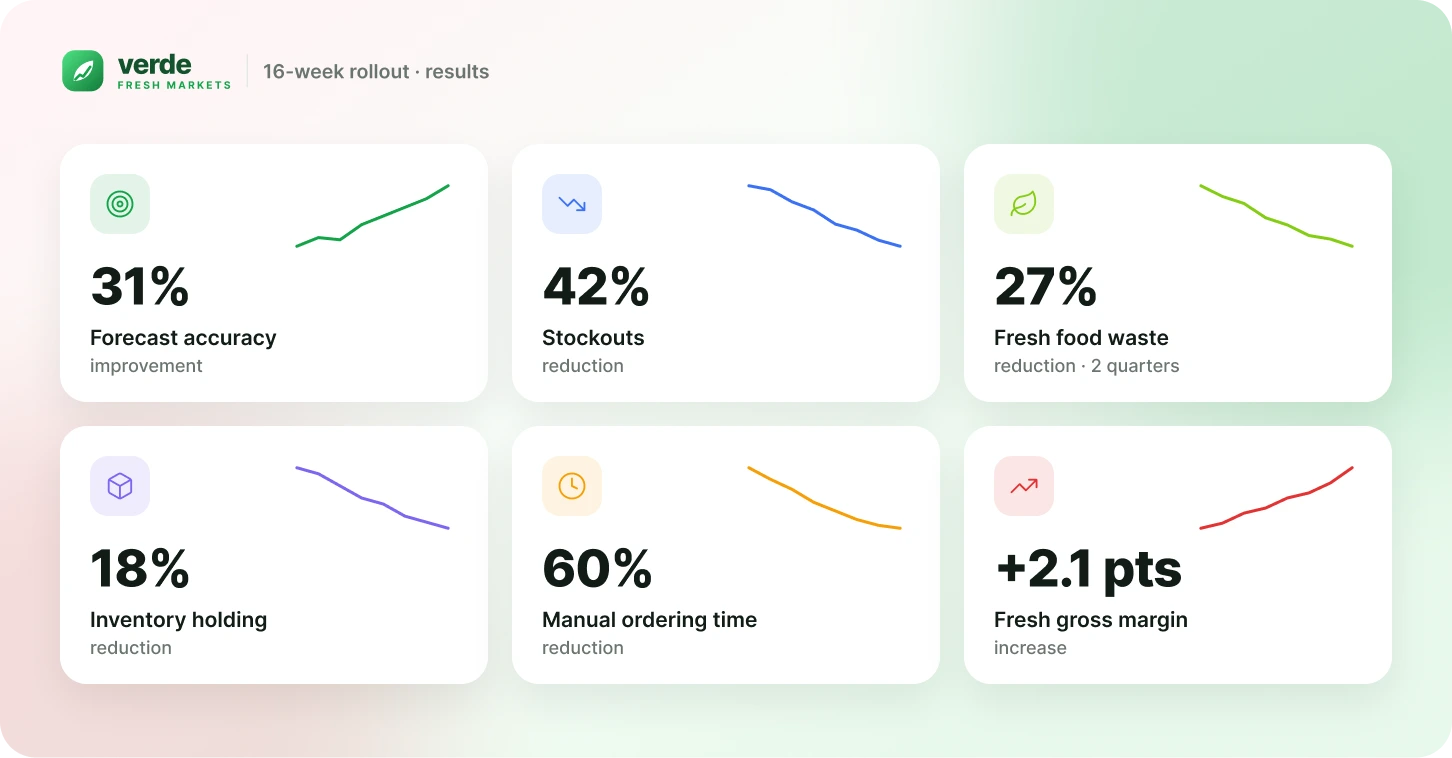
Following a sixteen-week phased rollout, FreshVale Markets reported improvements across its key planning and inventory measures:
 27%
Reduction in food waste
Fresh categories · first two quarters
The improvements addressed both sides of the original problem. Stores experienced fewer stockouts while carrying less inventory and throwing away less fresh food.
For planners, the change was practical too. Less time spent preparing routine orders meant more time for suppliers, exceptions and decisions that needed their experience. The team still had control, but fewer everyday tasks depended on manual work.
A Connected Supply Chain
Better demand predictions were only part of the solution. FreshVale also needed those predictions to work with the constraints of grocery replenishment.
A store might expect strong sales, but the order still had to account for available stock, delivery timing, minimum quantities and how long the product would remain fresh. The platform brought those factors into the same workflow.
Planners could review the recommended quantity, understand the reasoning and identify orders that needed attention. Suppliers received approved orders through the connected ordering process.
That connection mattered. It helped turn forecasts into decisions stores could act on, rather than another set of figures to review in a spreadsheet.
In Their Own Words
“We went from ordering guesswork to forecasts we can trust. Stockouts are down, write-offs are down, and my planners finally have time to think instead of react.”
Sarah Mitchell, Head of Supply Chain, FreshVale Markets
If your stores are losing sales to empty shelves while writing off unsold fresh stock, we can help you assess where forecasting and replenishment are falling short.
Red Star Technologies builds custom retail inventory-optimization platforms that connect sales, stock and supplier data with practical ordering decisions. Share how your team plans replenishment today, where the biggest problems occur and what you want to improve.
Talk to Our TeamTech Stack Summary
| Component | Tool / Framework |
|---|---|
| Frontend | React.js planner dashboard and store manager portal |
| Backend | Python, FastAPI |
| Machine Learning | LightGBM, XGBoost |
| Deep Learning | PyTorch Temporal Fusion Transformer |
| Replenishment Optimization | OR-Tools, rule-based engines |
| Data Pipelines | Apache Airflow, dbt |
| Data Warehouse | Snowflake |
| Application Data & Caching | PostgreSQL, Redis |
| Event Streaming | Apache Kafka |
| MLOps | MLflow |
| System Integration | REST APIs, EDI connectors |
| Infrastructure | Docker, Kubernetes, AWS |
Conclusion
FreshVale Markets needed a more dependable way to match stock with demand across its stores.
By combining AI demand forecasting with replenishment optimization and planner oversight, Red Star Technologies helped reduce stockouts by 42%, fresh food waste by 27% and manual ordering time by 60%. The platform gave FreshVale a clearer basis for everyday ordering, improving availability while reducing the stock and effort tied to the replenishment process.