Overview
VaultPay Solutions – A FinTech company providing secure digital payment processing and transaction management solutions, focused on fraud prevention and seamless payment experiences.
For VaultPay Solutions, stopping fraudulent payments was only half the problem. The other half was making sure genuine customers could still pay without trouble.
A legitimate payment flagged as suspicious can mean a lost sale. It can also leave a customer wondering whether to try again. But letting fraudulent transactions through carries its own cost.
VaultPay Solutions needed a better balance.
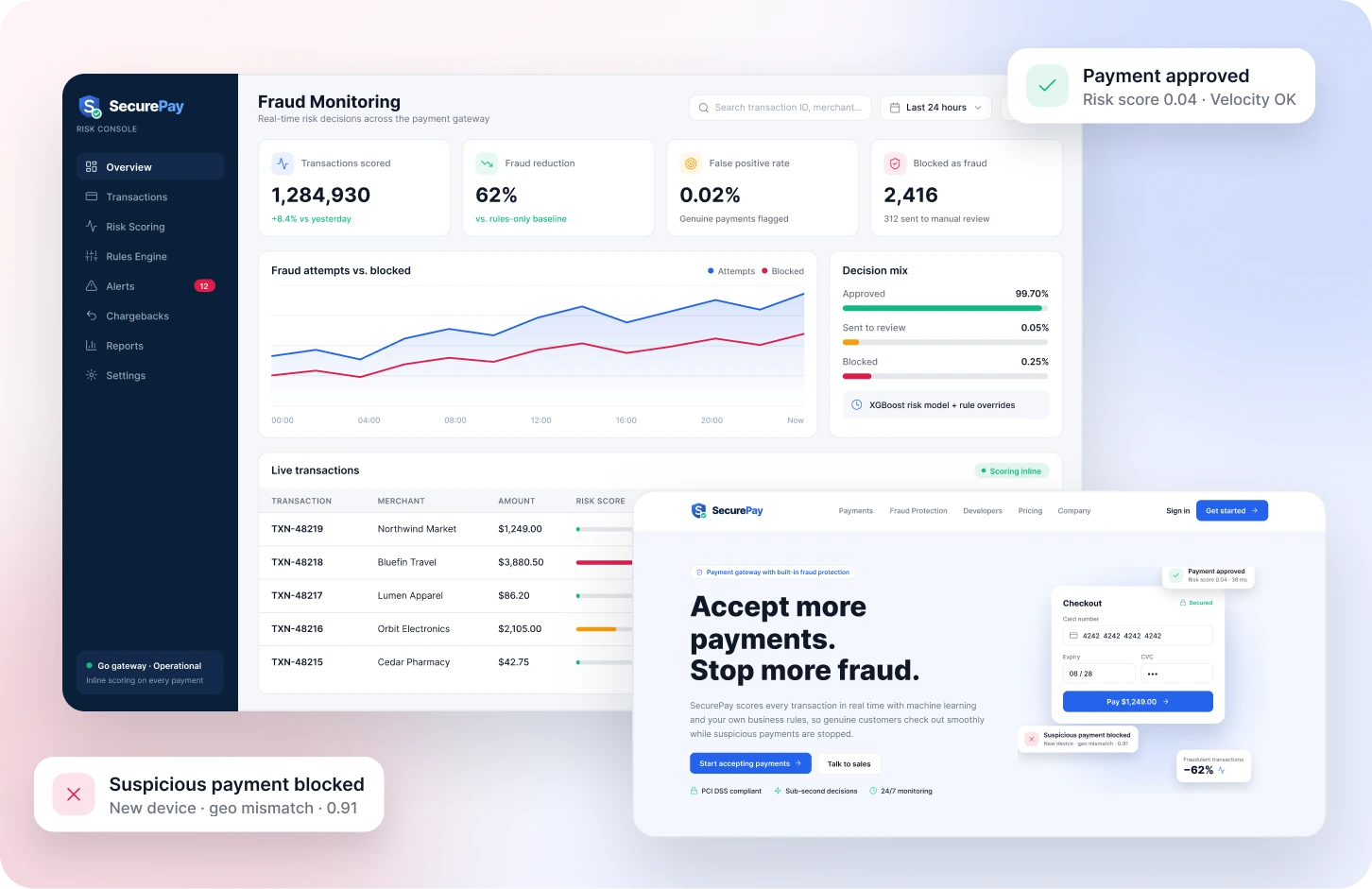
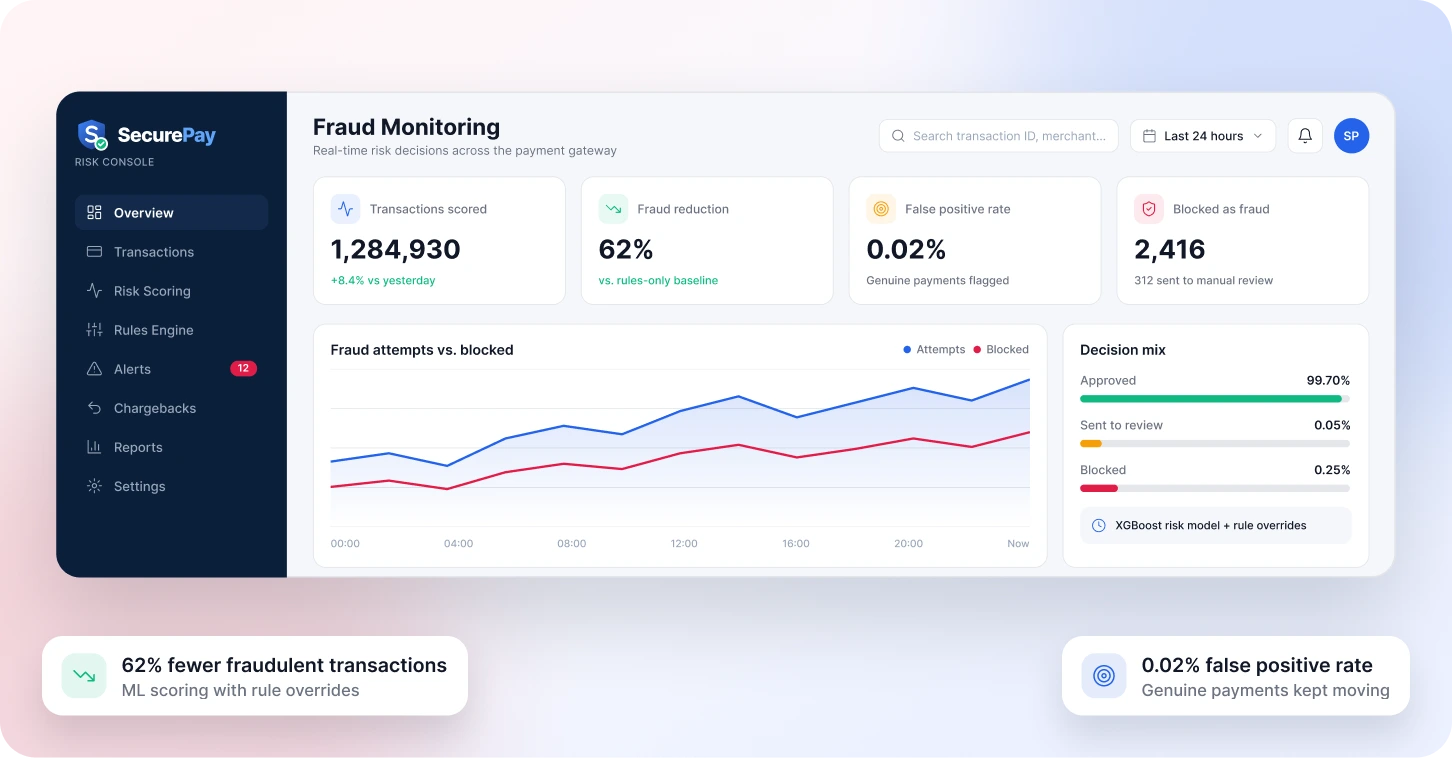
Red Star Technologies built an AI fraud detection platform that assessed transactions as they passed through the payment gateway. It combined machine learning risk scoring with rule-based controls, helping the client reduce fraudulent transactions by 62% while achieving a 0.02% false positive rate.
Initial Challenge
The client wanted to move beyond reactive rule evaluations. Fraudulent behavior was becoming more sophisticated, and the payment platform needed a way to identify suspicious patterns within the transaction flow.
There were two main challenges, and both mattered.
1. Avoiding Unnecessary Payment Blocks
The system needed to flag suspicious activity without treating genuine customers as a risk.
Simply making the checks stricter would not solve that problem. VaultPay Solutions needed more precise decisions, so legitimate payments could proceed with fewer unnecessary interruptions.
2. Keeping Up with Transaction Volume
The platform also needed to evaluate thousands of payment requests per second.
That left little room for slow processing. Data retrieval, feature extraction and risk scoring all had to fit within the payment workflow. A fraud check might be accurate, but if it holds up checkout, it creates another problem.
Background
VaultPay Solutions operates in the financial technology and security industry, with a team of 8–16 employees.
The company needed a proactive, automated way to flag fraudulent transactions while preserving a straightforward checkout experience.
We integrated a multi-layered anomaly detection platform into its transactional API gateway. This brought risk evaluation into the existing payment flow, where the result could inform the transaction decision as it happened.
Solution Design and Implementation
1. Built an Inline Risk Scoring Pipeline
We developed a real-time scoring service that evaluated incoming payment requests.
The pipeline followed a clear sequence:
Inline risk scoring pipeline
-
 01
Payment payload
-
 02
Go gateway
-
 03
Feature extraction
-
 04
ScyllaDB lookup
-
 05
XGBoost score
-
 06
Decision action
The gateway received the payment request. The system then prepared the transaction features, retrieved supporting data from ScyllaDB and passed the inputs to XGBoost.
The resulting risk score informed the decision action. Each step supported the same goal: assessing the payment quickly enough to be useful within checkout.
2. Brought Transaction Data into the Decision
The evaluation combined information from the incoming payment with supporting data retrieved from ScyllaDB.
This gave the scoring process more context to work with. Rather than evaluating an isolated condition, the model could assess the prepared inputs together and identify patterns associated with suspicious activity.
That context was an important part of the approach. The client needed better decisions, not just more checks.
3. Kept Rule-Based Controls Alongside ML Scoring
Machine learning scoring worked alongside rule-based overrides.
The model supplied a risk score, while explicit rules provided boundaries for the decision process. This allowed the platform to use ML evaluation while retaining controls for situations covered by defined business rules.
It was also one of the clearest lessons from the project. Rules still had a role. They worked alongside the model rather than being removed altogether.
4. Connected Fraud Detection to the Payment Gateway
The backend was built in Go, with the evaluation pipeline integrated into the transactional API gateway.
The architecture centered on the client's requirement for high transaction throughput and sub-second anomaly detection. Risk assessment needed to happen while the payment was being processed, without adding unnecessary delay.
The Results
The implementation achieved two key outcomes:
The reduction in fraudulent transactions addressed the client's main security concern. The low false positive rate addressed the customer side of that concern: limiting the number of genuine payments incorrectly flagged.
Both results mattered. Catching more fraud was valuable, but the client also needed legitimate customers to move through checkout smoothly.
A More Connected Payment Decision
The platform brought transaction data, model scoring and rule-based controls into one process.
The Go gateway handled incoming requests. ScyllaDB supplied supporting data, XGBoost generated the risk score, and the decision layer used that score alongside the defined controls.
For VaultPay Solutions, this meant fraud evaluation became part of the payment workflow itself. The system could assess suspicious activity at the point where a decision was needed.
In Their Own Words
“The anomaly detection model drastically cut chargebacks while preserving smooth transaction flows for our users.”
Client, VaultPay Solutions
Lessons Learned
- Combine machine learning with rule-based controls: Rule-based overrides provided practical safety boundaries for automated scoring.
- Evaluate fraud reduction alongside false positives: Detecting fraudulent payments must be balanced with avoiding unnecessary interruptions for genuine customers.
- Keep risk assessment fast: Data retrieval, feature extraction and scoring need to fit within the checkout workflow without adding unnecessary delay.
If your platform is missing suspicious payments or flagging too many genuine customers, the starting point is understanding where those decisions are going wrong.
Red Star Technologies can help you assess your payment workflow and develop a custom fraud detection solution around your APIs, transaction requirements and business rules.
Let's TalkTech Stack Summary
| Component | Technology |
|---|---|
| Frontend | Vue.js |
| Backend and API gateway | Go (Golang) |
| Machine learning | XGBoost and PyTorch |
| Database | ScyllaDB |
Conclusion
VaultPay Solutions needed to identify fraudulent transactions while keeping legitimate payments moving.
We built an anomaly detection platform that connected machine learning risk scoring with its payment gateway and rule-based controls. The implementation achieved a 62% reduction in fraudulent transactions and a 0.02% false positive rate, helping the client improve fraud prevention without losing sight of the customer experience.