Overview
CartNova Commerce – A modern e-commerce retail company offering a wide range of products online, focused on personalized shopping experiences and improving customer conversions through technology.
A shopper's interests can change as they browse. They might arrive looking for one product, compare a few alternatives, then start exploring something different.
CartNova Commerce needed its recommendations to keep up with that activity. Its static, rule-based system needed to be replaced with an approach that could use live shopping behavior to personalize recommendations during the same session.
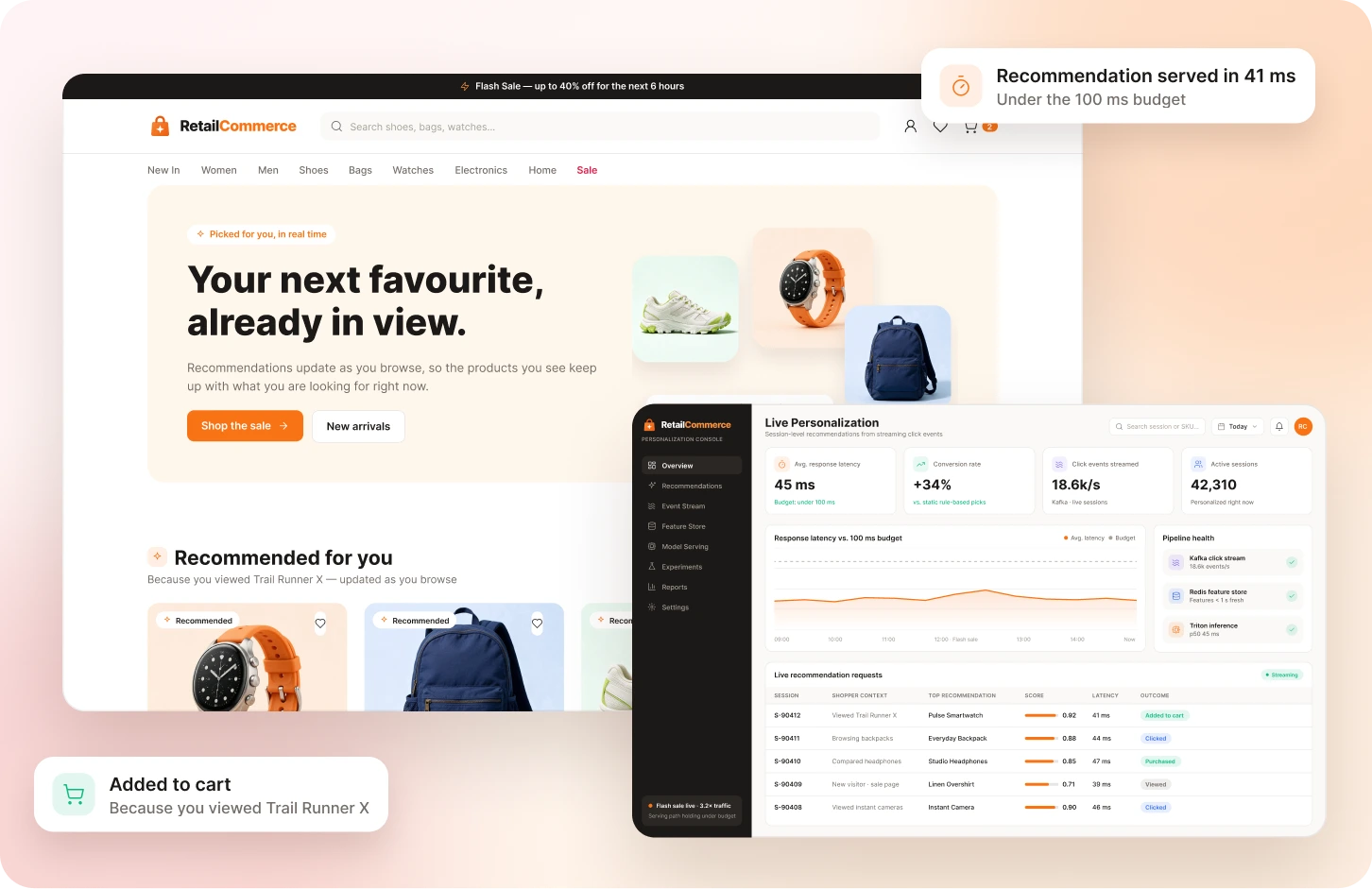
Red Star Technologies built an e-commerce recommendation engine powered by streaming analytics and machine learning inference. The implementation achieved a 45ms average response latency and a 34% increase in conversion rates.
The goal was straightforward: show shoppers relevant products while they were still interested, and do it quickly.
Initial Challenge
CartNova Commerce needed to deliver personalized product recommendations based on live clickstream activity.
Static rules could not provide the session-level responsiveness the company needed. The new system had to process incoming activity, update the information used by the model and return recommendations within a tight response window.
Two requirements shaped the work.
1. Delivering Recommendations in Under 100 Milliseconds
The latency budget was less than 100 milliseconds.
That meant the system needed to infer preferences and deliver recommendations without making shoppers wait. Collecting fresh data was only part of the challenge. That data also had to be available quickly enough to influence the next recommendation.
2. Handling Flash Sale Traffic
Flash sales introduced another pressure: sudden increases in concurrent shopping activity.
The architecture needed to accommodate those surges without degrading recommendation delivery. More shoppers meant more click events and more inference requests, all arriving within the same short time frame.
Speed mattered during ordinary browsing. It mattered even more during a sale.
Background
CartNova Commerce operates in e-commerce and digital retail, with a team of 8–12 employees.
The company required a real-time recommendation system that could personalize active shopping sessions. Its aim was to replace static rules with sub-second predictive modeling based on what shoppers were clicking at that moment.
We built a streaming analytics architecture that connected live click events with a feature store and model-serving layer. This allowed updated session information to feed into product recommendations while the shopper continued browsing.
Solution Design and Implementation
1. Built a Streaming Feature Store
We constructed a live processing pipeline to move shopping activity into the recommendation workflow:
Streaming recommendation pipeline
-
 01
Click event
-
 02
Kafka stream
-
 03
Feature store update
-
 04
Redis cache
-
 05
Inference request
-
 06
Triton serving
Apache Kafka handled the incoming clickstream. The pipeline updated the features held in Redis Enterprise, making them available to the model-serving layer.
This gave the recommendation engine a way to use current session activity, rather than relying only on fixed recommendation rules.
2. Separated Feature Updates from Model Inference
Feature ingestion and inference served different purposes, so we kept them decoupled.
The ingestion pipeline processed incoming click events and updated the feature store. The inference layer used the available features when a recommendation request arrived.
That separation was central to the design. A recommendation request did not need to wait for the entire event-processing workflow to run from the beginning.
Fresh data mattered, but so did keeping the response path short.
3. Connected Live Features to Triton Model Serving
We used a Python model-serving setup with Triton Inference Server to generate predictions from the available features.
The streaming pipeline supplied updated inputs, while the serving layer handled inference requests. Together, they supported real-time product recommendations based on activity within the shopper's current session.
This was the shift the client needed: recommendations that could respond as browsing interests changed.
4. Designed Around Peak Shopping Activity
The architecture separated incoming event processing from recommendation serving to address the client's peak concurrency requirements.
During flash sales, clickstream ingestion and inference requests could place pressure on different parts of the system. Keeping those responsibilities separate helped prevent feature-processing work from becoming a direct dependency in the response path.
The design focused on maintaining a fast response path as shopping activity increased.
The Results
The implementation achieved:
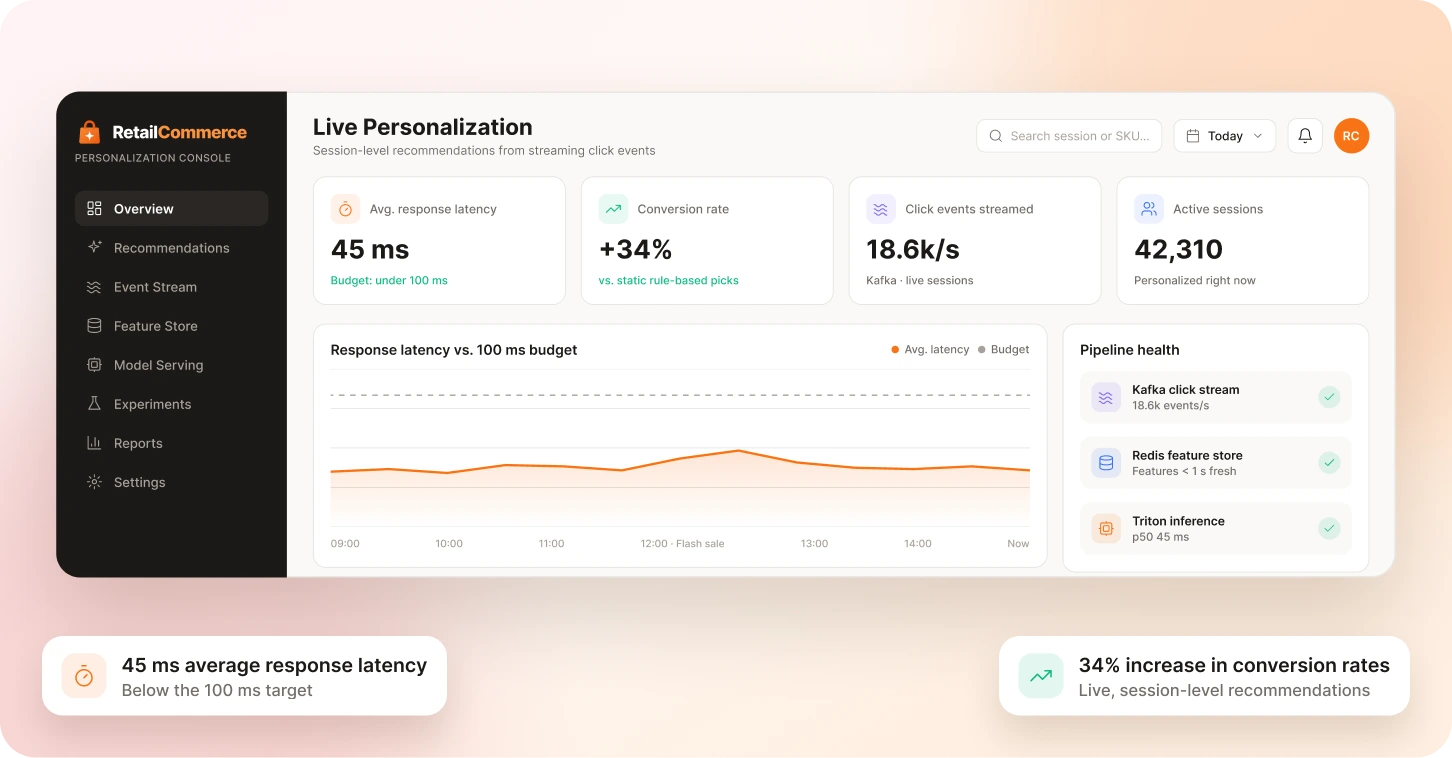
The 45ms average response latency was below the client's 100ms target. It showed that the engine could deliver recommendations quickly enough to support the active shopping experience.
The conversion increase addressed the commercial goal. CartNova Commerce wanted personalization that helped shoppers move toward a purchase, and the reported result was a 34% increase in conversion rates.
These measures describe different parts of the outcome. One reflects responsiveness. The other reflects business performance.
Session-Based Product Recommendation
The system connected what a shopper was doing with the recommendations served during that session.
Click events entered through Kafka. Updated features became available in Redis Enterprise. The inference layer then used those features to generate predictions for recommendation requests.
For CartNova Commerce, this created a more responsive approach to e-commerce personalization. Recommendations could draw on live activity while the customer was still browsing, when that information was most useful.
In Their Own Words
“The sub-second recommendation engine directly elevated our checkout conversion metrics across all product categories.”
Client, CartNova Commerce
Lessons Learned
- Separate feature ingestion from model inference: Decoupling these processes helped maintain low response latency.
- Make live behavior available for recommendations: Clickstream data needs to reach the feature store quickly enough to influence the current shopping session.
- Deliver recommendations while they are relevant: Timing matters when shoppers are actively comparing products and deciding what to buy.
If your store still relies on fixed recommendation rules, there may be an opportunity to make better use of live browsing activity.
Red Star Technologies can help you assess your recommendation workflow and develop a custom system around your storefront, data and performance requirements.
Tell us how your customers shop, where your current recommendations fall short and what you want to improve.
Let's Talk to Our TeamTech Stack Summary
| Component | Technology |
|---|---|
| Frontend | Next.js |
| Streaming engine | Apache Kafka |
| Model serving | Python with Triton Inference Server |
| Database and feature cache | Redis Enterprise |
Conclusion
CartNova Commerce needed product recommendations that could respond to live shopping activity within a demanding latency budget.
Red Star Technologies built a streaming recommendation architecture that connected clickstream events, feature updates and ML inference. With a 45ms average response latency and a 34% increase in conversion rates, the implementation gave the client a faster, more responsive way to personalize active shopping sessions.